The building
The Municipal House in Prague: an Art Nouveau landmark on Republic Square
Who built the Obecní dům, when it opened and what Wikipedia records about its style, its art and its place beside the Powder Gate.
Choose my date ↗Quick answer
The Municipal House, or Obecní dům, is an Art Nouveau civic building at Náměstí Republiky 5 in Prague, beside the Powder Gate. Wikipedia says construction began in 1905 to designs by Osvald Polívka and Antonín Balšánek, and the Czech edition gives the solemn opening as 16 December 1912. It houses a concert hall and ballroom, the Smetana Hall, under a glass dome, with works by Alphonse Mucha, Jan Preisler and Max Švabinský, and a mosaic by Karel Špillar above its entrance.
A house for the city
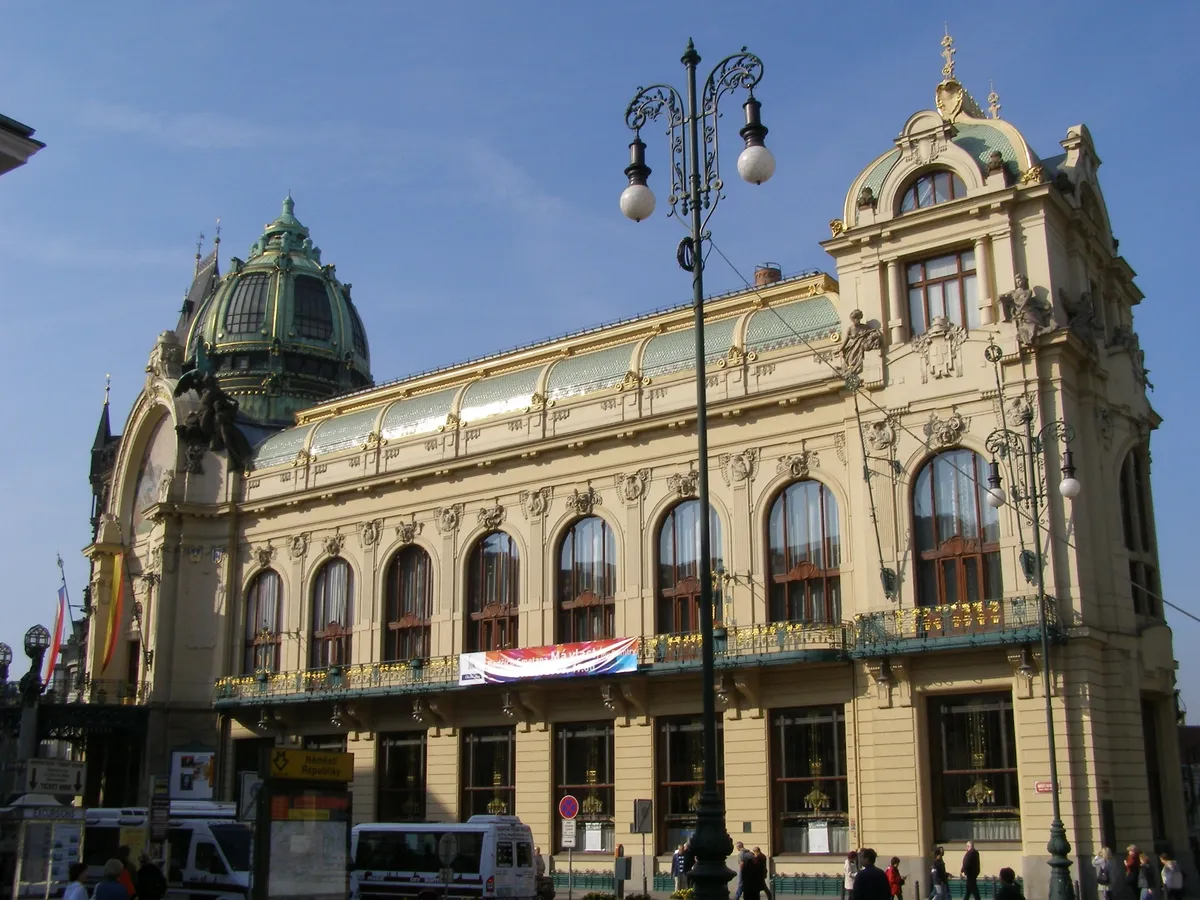
The name Municipal House translates the Czech Obecní dům, literally the community's house, and the building was conceived as a civic centre rather than a palace or a theatre. Wikipedia describes it as a concert hall, ballroom and civic building, with a café, a restaurant, a wine bar and an American bar, and says many rooms are open only on guided tours. The Czech article says an architectural competition produced the winning plans by Antonín Balšánek and Osvald Polívka, and that the house was built between 1905 and 1912. Those years place it in the Belle Époque, the period Wikipedia gives for Art Nouveau at its height.
What Art Nouveau means here
Wikipedia presents Art Nouveau as an international style of art, architecture and applied arts, popular from about 1890 to 1910, in the Belle Époque. It lists the core features as forms inspired by nature, such as the curves of plants and flowers, movement through asymmetry or whiplash lines, and modern materials, above all iron, glass and ceramics. The article gives local names for the style: Jugendstil in German-speaking lands, Secession in Austria-Hungary and secese in Czech. The Municipal House belongs to that family, and the glass dome over its main hall is a good example of the way the style used glass and metal to let light into the middle of a building.
The art inside
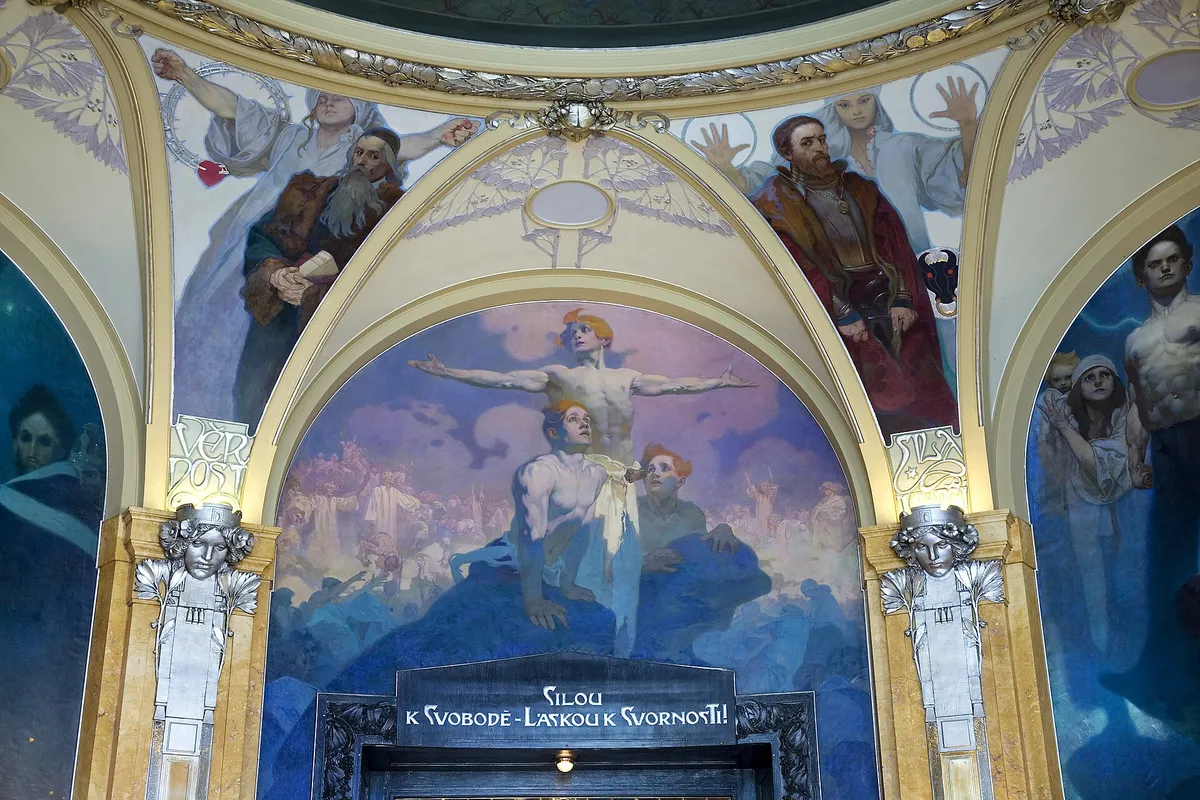
English Wikipedia says the Smetana Hall carries work by Alphonse Mucha, Jan Preisler and Max Švabinský, three Czech artists. Mucha's contribution is best known in the Mayor's Hall, where his decoration, begun in 1910 and finished in 1911, covers the domed ceiling and walls. Above the entrance outside, a mosaic by Karel Špillar looks over the square, flanked by allegorical sculpture groups by Ladislav Šaloun. For a visitor, the effect is of a building where architecture, painting, sculpture and decorative craft were designed together rather than added piece by piece.
The site and its neighbour
The Municipal House stands where a royal palace once did. Wikipedia says that palace was built around 1380 by Wenceslas IV, that kings of Bohemia lived in it from 1383 to 1485, and that it was demolished in the early twentieth century. Next door, the Powder Gate is a Gothic tower whose construction began in 1475; Wikipedia says the tower was meant to be an attractive entrance into the city and, despite its name, was never used to store gunpowder. The Czech article on the Municipal House adds that the house forms part of a national cultural monument together with the Powder Gate.
The Smetana Hall
The concert hall is the part of the house most visitors come for. Wikipedia describes it as a concert hall and ballroom with a glass dome, and the Czech edition says it holds about 1,200 listeners and that the Prague Symphony Orchestra performs there. Wikipedia's article on that orchestra says it was founded in 1934 and carries a photograph of it performing in the Smetana Hall. On this site the hall matters because the booked concert takes place in it, and the building rewards a look from the pavement whether or not you hold a ticket.
Restoration and today
The Czech article records a reconstruction between 1994 and 1997, at a cost it gives as two billion Czech crowns. That work is why the house looks so sharp today. Wikipedia lists the building among the national cultural monuments of the Czech Republic, and the Czech article names it as the 'Obecní dům hlavního města Prahy s Prašnou bránou', the Municipal House of the capital with the Powder Gate. Visitors can drink coffee in its café, eat in its restaurants or, on a concert evening, take a seat in the hall.
Frequently asked questions
Who designed the Municipal House?
Osvald Polívka and Antonín Balšánek, says Wikipedia, whose plans won an architectural competition according to the Czech edition.
When did it open?
Czech Wikipedia gives 16 December 1912, after construction began in 1905.
Can I see inside without a ticket?
Wikipedia says the building has a café, restaurants and bars, and that many rooms open only on guided tours.
Sources