The history
From royal court to republic: the history of the Municipal House site
A palace of Bohemian kings, a Gothic gate and a building where independence was proclaimed in 1918, as Wikipedia records them.
Choose my date ↗Quick answer
The ground beneath the Municipal House held a royal palace built around 1380 by Wenceslas IV, in which kings of Bohemia lived from 1383 to 1485, says Wikipedia. The palace was demolished in the early twentieth century, the present house opened on 16 December 1912, and the Czech edition says Czechoslovakia's independence was proclaimed in the building on 28 October 1918.
A palace before the house
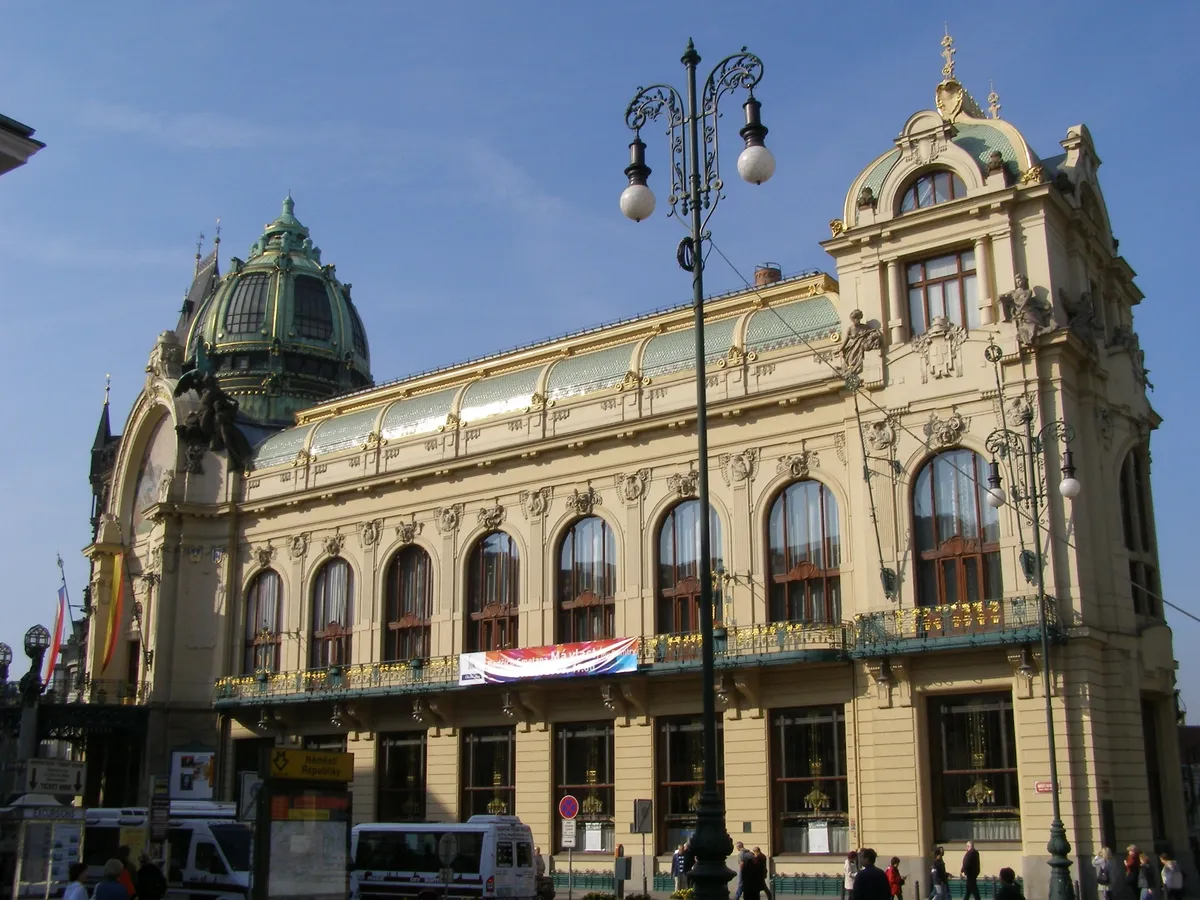
English Wikipedia says a royal palace was built on the site around 1380 by Wenceslas IV, that kings of Bohemia lived there from 1383 to 1485 and that it was demolished in the early twentieth century. The article on the Powder Gate links to this royal court in its account of the kings who passed through the tower. Taken together they paint a picture of an area that served as a seat of power long before it became a concert venue.
The Powder Gate next door
The Powder Gate is a Gothic tower whose construction began in 1475, according to Wikipedia, when Vladislav II placed the foundation stone; the city council had given him the tower as a coronation gift, says the article. It was intended to be an attractive entrance into the city instead of a defensive tower. The infobox gives its height as 65 metres. The page adds that, despite its name, it was never used to store gunpowder. It stands beside the Municipal House, and the Czech article on the house treats the two together as one national cultural monument.
Building the house
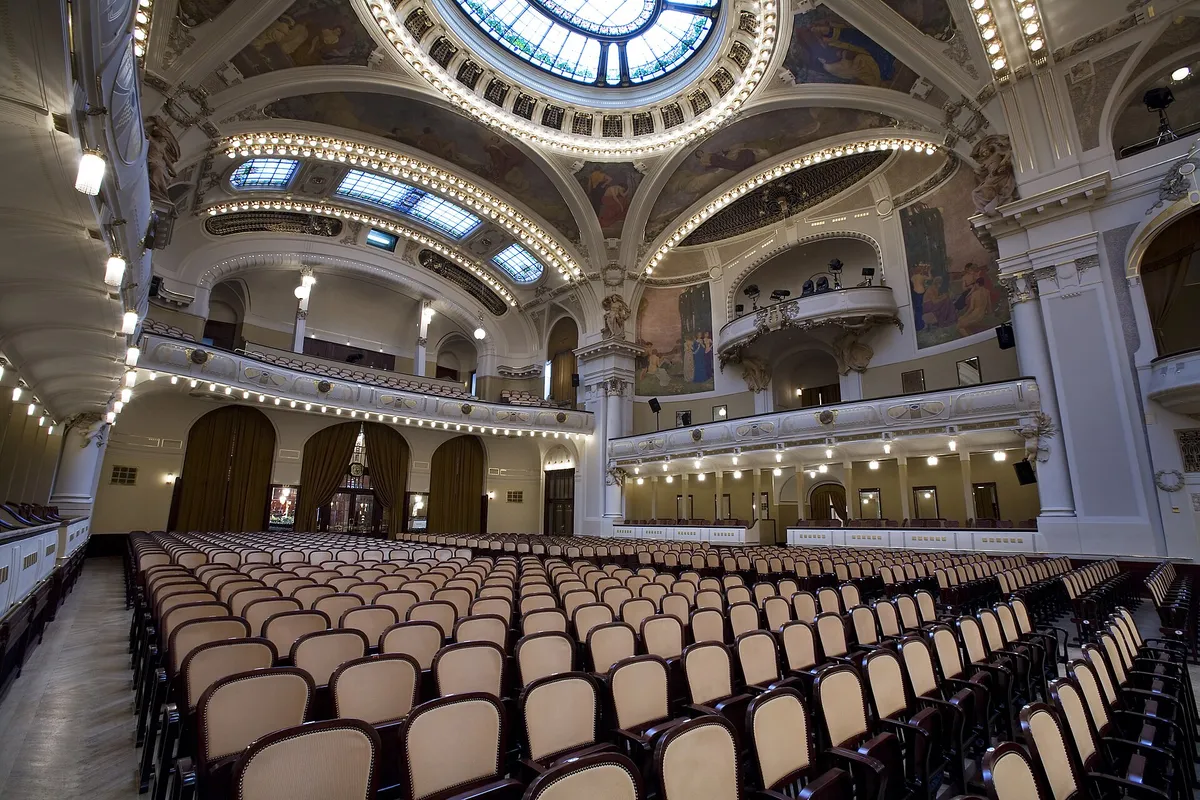
Wikipedia dates the beginning of construction to 1905, to designs by Osvald Polívka and Antonín Balšánek. The Czech article gives 1905 to 1912 as the building period and 16 December 1912 as the solemn opening. In those years the house gained its glass-domed hall, its Mucha decoration, its Špillar mosaic and its Šaloun sculpture, the features that still make it one of the best-known pieces of Prague's Art Nouveau.
28 October 1918
The Czech article says Czechoslovakia's independence was proclaimed in the building on 28 October 1918. English Wikipedia's article on the declaration of independence says Czech politicians peacefully took over command in Prague on that date, and it records that the Washington Declaration was published by the Paris-based Provisional Government on 18 October 1918, signed by Tomáš Garrigue Masaryk, Milan Rastislav Štefánik and Edvard Beneš. The two articles are not identical in focus, so this guide credits each for what it says and does not blend them into one story.
After independence
Alphonse Mucha, who decorated the Mayor's Hall in 1910 and 1911, designed the 100-koruna banknote and postage stamps for the new state, Wikipedia records, and presented his Slav Epic to the nation in 1928. The Municipal House itself continued as a civic and cultural centre and, according to the Czech article, underwent a reconstruction between 1994 and 1997. That long arc, from royal court to republic to concert hall, is what you are sitting inside when the music begins.
Frequently asked questions
Where is the Powder Gate?
Beside the Municipal House on Republic Square, in central Prague.
Was independence declared in the Municipal House?
The Czech Wikipedia article says it was proclaimed in the building on 28 October 1918.
Sources