The composer
Smetana and Má vlast: the composer behind the hall's name
Who Bedřich Smetana was, what Má vlast contains and why a river piece called Vltava is the one most people know.
Choose my date ↗Quick answer
Bedřich Smetana, born on 2 March 1824 in Litomyšl and died on 12 May 1884 in Prague, wrote the cycle of six symphonic poems Má vlast, 'My Country'. Wikipedia dates its composition to 1874 to 1879 and says the complete cycle was first performed on 5 November 1882 at the Žofín Palace under Adolf Čech. The second poem, Vltava, about the river through Prague, is his best-known orchestral work.
A composer and a hall
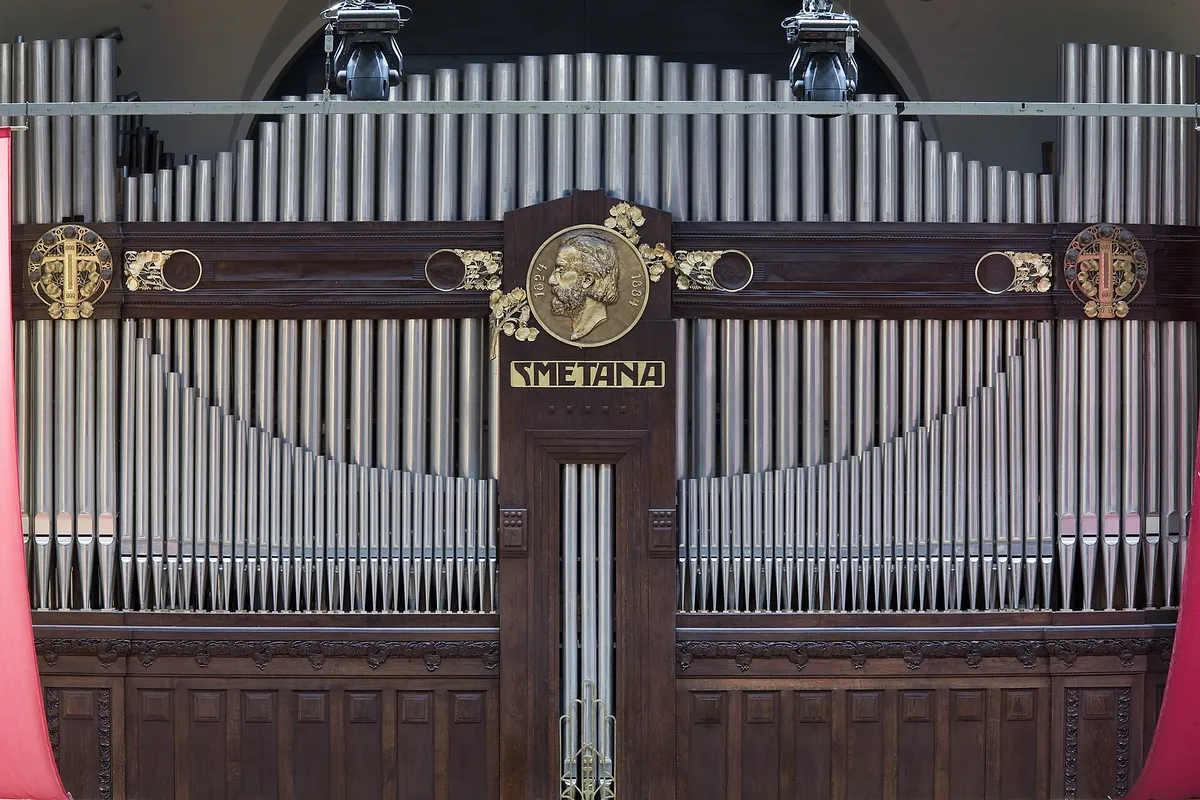
The Smetana Hall takes its name from the composer, and the organ case inside carries his name over a medallion portrait. That is a courtesy and a reminder, not a promise about the programme, because the programme, the page says, changes from one date to the next. Even so, a concert hall named for a national composer is a good prompt to learn about him, and Wikipedia gives a clear outline of his life.
A life in brief
Wikipedia places Smetana's birth on 2 March 1824 in Litomyšl, Bohemia, then in the Habsburg Empire, and his death on 12 May 1884 at the Kateřinky Lunatic Asylum in Prague. His opera The Bartered Bride premiered on 30 May 1866 at the Provisional Theatre in Prague, in its original two-act version with spoken dialogue, and reached its definitive three-act form in September 1870. He was principal conductor of that theatre from 1866 and resigned in 1874. In the same year he became deaf: the article says he lost hearing in his right ear and then in his left, and was completely deaf by the end of 1874.
What Má vlast contains
Wikipedia lists the six poems in order: Vyšehrad, Vltava, Šárka, Z českých luhů a hájů (From Bohemia's Woods and Fields), Tábor and Blaník. It dates them by composer's completion: Vyšehrad between late September and 18 November 1874, Vltava between 20 November and 8 December 1874, Šárka by 20 February 1875, From Bohemia's Woods and Fields by 18 October 1875, Tábor by 13 December 1878 and Blaník by 9 March 1879. So the cycle spans 1874 to 1879, a stretch that began in the very year the biography says Smetana went deaf.
Vltava, the river piece
Vltava is the second poem, and the article calls it the best known of the six, often performed on its own. It is about thirteen minutes long and in E minor, according to Wikipedia, and it was premiered on 4 April 1875 under Adolf Čech. It depicts the river that flows through Prague, which is why the piece is so closely tied to the city. The Wikipedia text gives an audio length of about twelve minutes and fifty-one seconds, so allow for variation in performance.
First performance and a spring tradition
The article says the complete cycle was first performed on 5 November 1882 at the Žofín Palace in Prague under Adolf Čech. Since 1952, it adds, Má vlast has opened the Prague Spring International Music Festival on 12 May, the anniversary of Smetana's death. The festival article says the Municipal House complements the festival's traditional venue and has a larger seating capacity. None of this means you will hear Má vlast at a booked concert; it is background for anyone who wants to know why the hall carries his name.
Frequently asked questions
Will the concert include Smetana?
The listing says the programme varies by date and does not promise a set list, so check the option for your date.
What is Vltava?
The second of the six poems in Má vlast, a piece about the river through Prague, and Smetana's best-known orchestral work, says Wikipedia.
Sources